Custom 3D Embroidered Patches for Volunteer Fire Departments & Fire Station Community Branding
Core Advantages of 3D Embroidered Patches for Volunteer Fire Departments
Volunteer fire stations are deeply rooted in small towns, rural communities and suburban neighborhoods across the United States. They respond to structure fires, vehicle accidents, wildfire threats, medical calls and seasonal emergencies. Station branding is not just decoration; it supports team identity, community recognition, volunteer pride and local fundraising efforts.
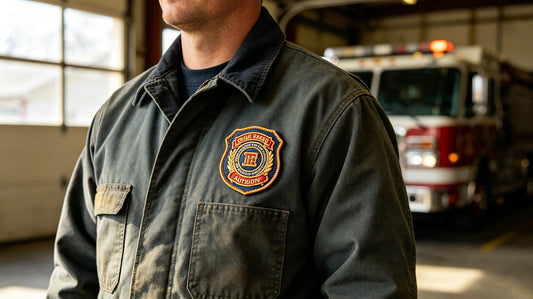
Firefighters and volunteers work in extreme conditions. Turnout gear, station hoodies, duty shirts and caps are exposed to heat, smoke, water, mud, dirt, equipment abrasion and repeated washing. Cheap heat‑transfer prints crack, fade and peel after heavy use. Flat embroidery works, but it does not deliver the same sense of pride, tradition and tactile identity that fire department patches deserve.
Custom 3D embroidered patches offer a durable, high‑visibility solution. Colorfast polyester thread resists fading, washing and abrasion. The raised foam structure creates a tactile, badge‑like presence that feels appropriate for fire department traditions. Unlike cheap printed logos, embroidered patches stay attached through rigorous training, fire calls, parades, community events and regular laundering.
Safety and practicality are critical in fire department environments. Sharp metal pins and rigid plastic badges are not recommended near turnout gear, gloves, hoses, tools and equipment. They can scratch gear, catch on fabric, create safety hazards during movement, and even melt or deform under high heat. Soft foam‑backed 3D embroidered patches eliminate these risks while still delivering a clear, professional look.
Beyond uniform identification, patches serve important community and fundraising purposes. Many volunteer fire departments operate on limited budgets, relying on donations, fundraisers, pancake breakfasts, boot drives and community event sales. Custom 3D embroidered patches can be sold as station pride merchandise, given to junior firefighters, presented to honorary members, or used as thank‑you gifts for local donors and community sponsors.
Small‑batch custom orders are especially useful for volunteer stations. Many fire departments need limited quantities for specific events: annual open house, 9/11 memorial ceremony, holiday parade, wildfire response tribute, or fundraising campaign. Small‑batch production allows stations to create meaningful keepsakes without overspending or overstocking finished merchandise.

Design Guidelines for Fire Department 3D Embroidered Patches
Fire department patch designs should balance tradition, legibility and embroidery durability. Station names, city names, engine numbers, battalion numbers and honorary titles must remain readable from a distance. Bold block fonts and classic serif fonts work best. Thin script fonts and overly decorative lettering tend to lose clarity when converted into stitched embroidery over 3D foam.
Traditional motifs include fire helmets, axes, ladders, hydrants, Maltese cross elements, flames, shields, stars, eagles and station numbers. These symbols are recognizable and respected within fire service culture. However, designs must be simplified for production. Photorealistic fire scenes, complex machinery and tiny text may look strong digitally, but they do not always translate into durable embroidery.
Size selection depends on placement. For shoulder or chest patches on turnout gear, 75mm to 100mm is common. For caps, beanies and duty shirts, 45mm to 65mm works better. For jacket back patches, larger sizes may be used, but foam height and stitch density must be carefully controlled to avoid stiffness. Patches smaller than 35mm are not recommended for official identification because the 3D effect and small text become difficult to recognize.
Color palettes should reflect fire department identity. Traditional colors include red, navy blue, black, gold, white and orange. These colors are highly visible and feel appropriate for public safety branding. For fundraising and community merchandise, stations may also add cream, charcoal, forest green or patriotic accents. Each patch should be limited to five to seven thread colors to maintain clarity and cost efficiency.
Shape options include classic shields, rounded rectangles, curved banners, custom helmet outlines and badge‑style contours. Rounded edges are preferred because they reduce snags on turnout gear, gloves, hoses and equipment. Sharp corners and jagged flame outlines should be softened for practical use.

Material & Backing Selection
For fire department applications, the best combination is high‑tenacity polyester embroidery thread with medium‑density 3D foam. Polyester thread holds up to repeated washing, high temperatures, smoke exposure and heavy abrasion. Medium‑density foam creates a raised, badge‑like texture without making the patch too stiff for turnout gear.
Extra‑thick foam should be avoided. It can make patches rigid, more likely to catch on equipment, and harder to sew onto heavy gear. The goal is a patch that feels durable, professional and functional, not bulky.
✅ Sew‑on backing: Best for permanent placement on turnout gear, station jackets, honorary jackets and official uniforms. Sew‑on patches provide the strongest long‑term attachment under extreme conditions.
✅ Iron‑on backing: Suitable for caps, hoodies, event shirts and limited‑run fundraising merchandise. It is not recommended for active turnout gear, because high‑heat washing and heavy use can weaken adhesive over time.
✅ Hook and loop backing: Useful for training shirts, event staff, parade uniforms and temporary assignments. It allows patches to be swapped between garments without sewing.

Production Standard & Quality Control
Merrow overlocked edges are essential for fire department patches. Raw hot‑cut edges fray quickly under heavy use, washing and equipment contact. Merrow wrapping seals the perimeter, improves durability and gives the patch a clean, professional border.
Foam height should be kept between 1.8mm and 2.5mm for official station patches. This range creates a noticeable three‑dimensional badge effect while remaining flexible enough for turnout gear. For cap patches and smaller apparel patches, 1.5mm to 2mm is often sufficient.
Physical pre‑production samples are strongly recommended before bulk ordering. Fire departments often have emotional, historical or ceremonial deadlines, such as memorial events, station anniversaries, open houses and holiday parades. Samples should be reviewed for color accuracy, foam height, merrow edge quality, stitch density and readability of station names, numbers and symbols.
Upon bulk delivery, a full inspection is necessary. Quality checks should include consistent stitching, uniform merrow borders, no exposed foam and no loose threads. Patches with distorted graphics, uneven edges, thread shedding or poor color matching should be rejected. For public safety and ceremonial branding, craftsmanship directly reflects station pride.

Installation, Washing & Maintenance Guide
For sew‑on patches, stitching completely around the outer perimeter provides the best durability. This is especially important for turnout gear and heavy station jackets that will be exposed to water, mud, heat and equipment abrasion. Strong thread and even stitching help the patch survive repeated use and washing.
When applying iron‑on patches, the heat press temperature should be set to 150℃ with even pressure for 12 to 15 seconds. Always test on scrap fabric first, especially when applying to caps, hoodies or blended materials. Iron‑on adhesion will degrade over time with heavy laundering, so this method is better for event merchandise than official turnout gear.
Embroidered fire department apparel should be washed inside out on a cold gentle cycle. Bleach should be avoided because it fades thread colors and can damage the internal foam structure. Heavily soiled areas near the patch should be cleaned gently rather than scrubbed directly over the embroidery. Tumble drying on low heat or air drying is recommended. High heat can permanently compress 3D foam and destroy the raised texture.
When storing ceremonial patches, honorary badges or fundraising merchandise, heavy objects should not be stacked directly on embroidered surfaces. This helps preserve the three‑dimensional shape and keeps patches ready for ceremonies, donations or event distribution.

Common Defects & Troubleshooting
Foam flattening is usually caused by low‑density foam, high‑temperature drying or heavy compression during storage. The solution is to use medium‑density foam and follow cold‑wash, low‑heat drying instructions.
Fraying edges occur when hot‑cut edges are used instead of merrow overlocking. All orders for official fire department patches should explicitly specify merrow wrapped edges.
Snags and loose threads are often the result of insufficient stitch density. This should be confirmed during the sample approval stage, especially for patches that will be used on turnout gear.
Color mismatches between sample and bulk production can be avoided by approving physical thread swatches before manufacturing. Digital proofs are helpful, but physical swatches provide the most accurate representation under real lighting conditions.
FAQ
Are 3D embroidered patches suitable for volunteer fire department turnout gear?
Yes, sew‑on 3D embroidered patches are durable, flexible and safer than metal pins or hard badges for use near turnout gear, gloves and equipment.
Can patches be used for fire department fundraising merchandise?
Absolutely. Fire station patches are popular fundraising items, especially during open houses, pancake breakfasts, boot drives and community safety events.
Which backing is best for official fire station uniforms?
Sew‑on backing provides the strongest durability for turnout gear, station jackets and honorary uniforms.
Can small‑batch orders support memorial and ceremonial events?
Yes. Small‑batch production allows fire departments to create limited‑edition patches for memorials, station anniversaries, tributes and special ceremonies without large inventory risk.
Can traditional fire department symbols be converted into 3D embroidered patches? Yes. Classic shields, helmets, axes, hydrants and station numbers can be simplified into durable, highly recognizable 3D embroidered patch designs.
Tags:
Previous
Custom 3D Embroidered Patches for Local Coffee Roasters & Specialty Coffee Shop Brand Merchandise
Next
Custom 3D Embroidered Patches for Summer Camp Organizations & Youth Overnight Camp Brand Merchandise