15 Common Custom Patch Mistakes & How to Avoid Them Completely (2026)
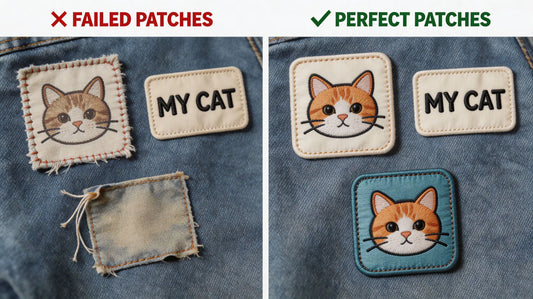
Many custom patch orders end in disappointment: blurry tiny text, faded colors, peeling backing, stiff uncomfortable texture, or batch inconsistency for team uniforms. Most customers blame factory quality, yet over 80% of defective patch results stem from preventable pre-order mistakes in design setup, material matching, size selection, and ordering logic.
After analyzing thousands of custom patch feedback cases, we summarize the 15 most frequent custom patch mistakes covering design, artwork files, material & backing, craft selection, bulk ordering, and daily usage. Every mistake includes clear consequences and actionable solutions, helping you eliminate trial and error and get flawless patches on the first try. Before you order custom embroidered patches, master this full avoidance guide to save cost and time.
This guide matches all patch types including embroidered, woven, PVC, and bulk team orders, suitable for personal customization, commercial merchandise, and corporate uniform batch production.
1. Design & Artwork File Mistakes (Root Causes of Blurry Patches)
Mistake 1: Using Low-Resolution Bitmap Images
Consequence:Blurry edges, pixelated details, and distorted patterns after embroidery. Low-resolution JPG/PNG files cannot support fine embroidery restoration, resulting in low-grade finished patches.
Fix:Always provide 300DPI+ high-definition images or vector files (AI/EPS/SVG). Vector files support infinite zoom without pixelation, ensuring ultra-clear pattern and text restoration.
Mistake 2: Too Many Colors & Complex Gradients
Consequence:Excessive color types increase production difficulty and cost. Complex unoptimized gradients cause color mixing, unclear layering, and floating color bleeding after washing.
Fix:Simplify color matching, control conventional patch colors within 4-6 types, and convert complex gradients into layered color blocks for stable embroidery presentation.
Mistake 3: Tiny Text & Overly Fine Lines
Consequence:Small fonts (below 4pt) and ultra-fine lines cannot be fully embroidered, leading to missing text, broken lines, and unrecognizable patterns.
Fix:Adjust font size above 5pt, thicken fine lines appropriately, and abandon redundant tiny details to ensure complete and clear pattern presentation.
Mistake 4: Ignoring CMYK Color Mode & Color Deviation
Consequence:Screen RGB colors differ greatly from actual embroidered thread colors, resulting in overall color difference and inconsistent tone between design draft and finished product.
Fix:Use CMYK color mode for design drafts, mark Pantone color numbers for high-precision orders, and confirm physical color swatches before mass production.

2. Craft & Stitch Density Mistakes (Affect Texture & Durability)
Mistake 5: Low Stitch Density for Long-Term Wear Patches
Consequence:Sparse stitches expose base fabric, look cheap, and loosen/fall off after multiple washes, leading to short service life.
Fix:Choose medium or high stitch density for daily wearing and long-term use patches to ensure full texture and washing resistance.
Mistake 6: Excessively High Density for Mini Patches
Consequence:Too many threads stacked in a small area make the patch stiff and hard, affecting wearing comfort and easy deformation by extrusion.
Fix:Adjust density dynamically according to patch size, reduce density appropriately for mini patches to balance fineness and softness.
Mistake 7: Blindly Adding 3D Puff for All Patterns
Consequence:3D puff on thin lines and small text causes thread bulging and blurry details, destroying pattern clarity instead of improving texture.
Fix:Apply 3D puff only to large-area solid color blocks; keep fine text and thin lines flat embroidered for clear details.
3. Backing & Material Mismatch Mistakes (Cause Peeling & Falling Off)
Mistake 8: Wrong Backing for Fabric Type
Consequence:Iron-on backing on high-temperature sensitive fabrics (nylon, thin polyester) causes fabric scalding and poor adhesion; peel-stick backing for daily washing clothes leads to frequent peeling.
Fix:Match backing by scenario: iron-on for conventional cotton clothes, sew-on for high-frequency washing, velcro for removable use, and peel-stick only for temporary events.
Mistake 9: Ignoring Material Scenario Adaptability
Consequence:Embroidered patches for long-term outdoor use fade and wear quickly; rigid PVC patches on thin casual clothes affect comfort and fitting effect.
Fix:Embroidered for daily indoor uniforms, woven for high-precision logos, PVC for outdoor tactical gear to maximize material performance.

4. Sizing & Layout Mistakes (Affect Overall Matching Effect)
Mistake 10: Inappropriate Patch Size for Garment Area
Consequence:Oversized patches crowd the clothing layout and look bulky; undersized patches are inconspicuous and fail to display brand/team recognition.
Fix:Match size by wearing position: 2-3 inches for chest patches, 3-4 inches for sleeve patches, 4-5 inches for full back patches, maintaining visual coordination.
Mistake 11: Irregular Pattern Layout & Asymmetrical Design
Consequence:Uncalibrated asymmetrical patterns cause inconsistent left-right visual balance, reducing overall aesthetics and grade.
Fix:Calibrate pattern symmetry before production, align text and pattern centers, and ensure neat and unified layout.
5. Bulk Order & Process Mistakes (Cause Batch Defects)
Mistake 12: Skipping Pre-Production Sample Confirmation
Consequence:Design deviation, color difference, or craft defects are only found after full batch production, resulting in large-area rework and cost waste.
Fix:Confirm physical pre-production samples and sign off all details before mass production, which is the most effective batch risk avoidance method.
Mistake 13: No Spare Patches Reserved for Bulk Orders
Consequence:Personnel changes, patch loss, and damage lead to insufficient quantity. Supplementary small-batch orders have higher unit prices and longer cycles.
Fix:Reserve 3%-5% spare patches for all team and bulk orders to meet daily replacement needs.
Mistake 14: Ignoring Batch Color Consistency Standards
Consequence:Different thread batches and dye formulas cause color difference in bulk patches, resulting in messy team uniform styling.
Fix:Require unified thread batches and fixed color calibration standards for bulk orders to ensure 100% batch consistency.

6. Daily Usage & Maintenance Mistakes (Shorten Patch Service Life)
Mistake 15: Improper Washing & Drying Habits
Consequence:High-temperature hot water washing, bleach use, and direct sunlight exposure cause patch fading, bleeding, thread loosening, and aging yellowing.
Fix:Adopt cold water gentle washing, avoid chemical detergents, and dry in shade to maintain long-term color and texture stability.
7. Zero-Mistake Custom Patch Ordering Checklist
To help you avoid all errors efficiently, we sort out a standardized pre-order checklist for one-click confirmation:
Artwork Check:300DPI+/vector file, clear text (≥5pt), reasonable color quantity, no excessive fine lines
Craft Check:Reasonable stitch density, targeted 3D puff usage, matched material for usage scenario
Backing Check:Backing type matches fabric and wearing cycle, avoid mismatched adhesion failure
Size Check:Size matches wearing position, balanced layout and visual proportion
Bulk Order Check:Confirm pre-production sample, reserve spare patches, lock batch color standards
Maintenance Prep:Clarify correct washing and drying methods to prevent post-wearing damage
Pro Tip:90% of bad patch results are avoidable with pre-order checks. When you custom embroidered patches with standardized processes, you can eliminate almost all defective and unsatisfactory results.

Final Thoughts
Custom patch failure is rarely caused by factory quality problems alone; most issues come from unreasonable design settings, mismatched material/craft selection, irregular ordering processes, and incorrect daily maintenance. Every common mistake corresponds to a clear avoidance rule, which can be completely eliminated through standardized pre-order confirmation.
Low-resolution files, inappropriate backing, unreasonable density settings, skipped sample confirmation, and wrong washing habits are the five major culprits of defective patches. By following the full-set avoidance guide and pre-order checklist in this article, you can achieve zero-mistake customization, no longer waste budget on rework and repeated orders, and obtain high-quality, high-consistency, and long-lasting perfect custom patches.
Whether it is personal personalized patches or large-scale team bulk orders, standardized error avoidance processes are the core premise of high-quality customization, maximizing the aesthetic value and practical life of every custom patch.

FAQ
Q:Why do my custom patches always look blurry?
A:Blurry patches are mainly caused by low-resolution artwork files, overly small text, excessive fine lines, or insufficient stitch density. You can solve this by uploading vector files, enlarging tiny details, and upgrading to medium/high density. You can get clear and sharp works when you order custom embroidered patches with optimized designs.
Q:What is the most common bulk patch order mistake?
A:Skipping pre-production sample confirmation is the most common and costly bulk order mistake. It may lead to full-batch color deviation and craft defects. Always confirm samples before mass production to lock all standards.
Q:Why do iron-on patches keep peeling off?
A:Peeling is caused by mismatched fabric materials, insufficient ironing temperature/pressure, or high-temperature machine washing. Avoid using iron-on backing on heat-sensitive fabrics and follow standard cold water maintenance rules.
Q:Is 3D puff embroidery suitable for all patch designs?
A:No. 3D puff only works well on large solid color blocks. Applying it to small text and thin lines will blur details and damage pattern clarity. Flat embroidery is more suitable for fine detailed designs.
Q:How to avoid color difference in bulk patch orders?
A:Unify thread batches and color calibration formulas, confirm physical color swatches, and fix design drafts before production. Standardized batch production processes can ensure 100% color consistency of bulk patches.
Tags:
Previous
Embroidery Patch Density Guide: High vs Low Stitch Density Pros & Cons (2026)
Next
Custom Patch Size Guide: Standard Sizes, Measurement & Placement Rules (2026)