Patch Backing Guide: Iron-On vs Sew-On vs Velcro vs Peel-Stick (2026)
When designing custom patches, most buyers focus on materials, colors, and sizes while overlooking one critical detail: backing type. The patch backing determines how your patches attach to garments, bags, and gear, directly affecting durability, wearing flexibility, washing resistance, and overall service life. Choosing the wrong backing leads to frequent peeling, falling off, inability to reposition, or permanent damage to fabrics.
There are four mainstream backing types for custom patches: iron-on heat seal, sew-on plain backing, hook-and-loop velcro, and peel-stick self-adhesive. Each backing has unique adhesive principles, strength limits, and applicable scenarios. No single backing fits all use cases. Whether you need permanent uniform fixation, removable tactical decoration, temporary event styling, or reusable brand patches, matching the right backing is the key to perfect customization. Before you order custom embroidered patches, master this full backing comparison guide to avoid attachment failures.
Combined with factory production data and long-term user feedback, we comprehensively analyze the pros, cons, durability, installation difficulty, cost, and best application scenarios of all four backings, providing zero-mistake selection standards for every custom patch order.
1. Iron-On Heat Seal Backing: Fast & Permanent Daily Choice
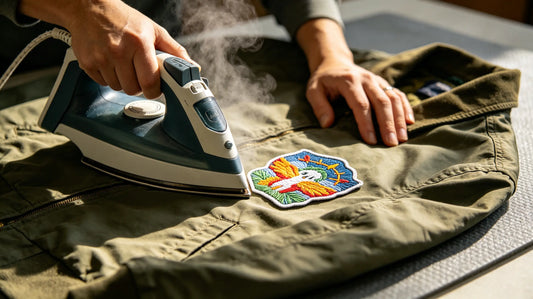
Iron-on backing, also known as heat seal backing, is the most popular and user-friendly patch mounting option. The back of the patch is coated with a layer of hot-melt adhesive, which melts and adheres tightly to the fabric surface under high temperature and pressure. It requires no sewing tools, realizing fast permanent bonding through simple ironing operation.
Core Advantages
The biggest advantage is tool-free and efficient installation. Users can finish firm fixation at home with a regular household iron or heat press in seconds. After proper ironing, the patch fits flat with the fabric without bulging or foreign body sensation. It features strong adhesion, good washing resistance, neat edge sealing, and no thread fraying. With moderate cost and wide compatibility, it is suitable for most conventional fabric materials and daily wearing scenarios.
Limitations & Disadvantages
Iron-on backing is semi-permanent and cannot be removed without damaging the fabric. Once pasted incorrectly, repositioning is difficult. It is not suitable for high-temperature sensitive fabrics such as nylon, polyester thin silk, and waterproof coated cloth, which are prone to fabric scalding and deformation. Frequent high-strength machine washing may cause edge warping and peeling after long-term use.
Best Application Scenarios
Daily casual clothing, denim jackets, cotton T-shirts, school uniforms, corporate work uniforms, and fixed decorative patches. Ideal for users who pursue convenient installation, flat fitting, and permanent fixation without frequent replacement. It is the most versatile backing for personal and small-batch team customization.

2. Sew-On Plain Backing: Ultra-Durable Permanent Heavy-Duty Option
Sew-on backing is a blank plain backing without any adhesive layer, requiring manual or machine stitching fixation. As the most traditional patch mounting method, it completely relies on stitching to fix the patch on the fabric, featuring unmatched durability and stability among all backing types.
Core Advantages
Extreme durability, completely resistant to repeated machine washing, high-temperature drying, and long-term friction. No adhesive failure or peeling problems, and the service life is synchronized with the clothing itself. Stitched fixation allows slight edge adjustment, with strong fabric compatibility, suitable for all thick and hard-to-bond fabrics. The stitching outline is neat and three-dimensional, improving the overall texture of the patch.
Limitations & Disadvantages
The installation process is relatively cumbersome, requiring sewing tools and certain manual skills, unable to complete quick fixation by hand. Professional sewing is needed for neat and beautiful stitching effects, increasing time and labor costs. Once fixed, it is permanent and cannot be disassembled at will.
Best Application Scenarios
High-frequency washing uniforms, outdoor work clothes, thick denim fabrics, long-term fixed team identification patches, and high-end customized clothing accessories. It is the preferred backing for commercial batch customization and long-term wearing scenarios with high durability requirements.
3. Velcro Hook & Loop Backing: Reusable & Removable Tactical Choice
Velcro backing consists of two parts: hook side (fixed on the patch back) and loop side (sewn on the clothing or gear). It adopts physical bonding, supporting free disassembly and repeated pasting, which is the exclusive backing for tactical and replaceable patch scenarios.
Core Advantages
100% reusable and removable, supporting arbitrary replacement and position adjustment of patches according to matching needs. No damage to clothing surface, no residual adhesive traces. The velcro structure has strong tensile force, excellent wear resistance, and stable bonding, not easy to fall off during outdoor sports and strenuous activities. It is convenient for daily switching and team equipment unified management.
Limitations & Disadvantages
The cost is higher than iron-on and sew-on backings. The velcro layer increases the overall thickness of the patch, resulting in slightly poor fitting performance on ultra-thin clothes. Fluff and debris are easy to accumulate in the velcro gap after long-term use, affecting adhesion. It is not suitable for formal business and minimalist lightweight clothing styling.
Best Application Scenarios
Tactical military uniforms, outdoor hiking gear, backpack decorative patches, sports team replaceable morale patches, and event variable identification patches. Perfect for scenarios requiring frequent replacement, free adjustment, and reusable use.

4. Peel-Stick Self-Adhesive Backing: Temporary & Tool-Free Quick Option
Peel-stick backing is covered with pressure-sensitive adhesive on the back, with a protective film on the surface. It can be firmly pasted by tearing off the film and pressing lightly, without ironing, sewing, or other auxiliary tools, realizing one-second quick installation.
Core Advantages
Extremely convenient operation, zero threshold installation, instant pasting and instant use. Low cost and fast production speed, suitable for short-term large-batch customized activities. No tools are required for disassembly and replacement, and temporary adjustment can be realized at any time. It will not cause permanent damage to clothing.
Limitations & Disadvantages
Poor durability, not washable or waterproof. It is easy to fall off after water soaking, friction, and long-term wearing. The adhesive will age and lose viscosity after a period of time, unable to support long-term daily use. It is only suitable for temporary decoration and cannot be used for fixed wearing scenarios.
Best Application Scenarios
Short-term event activities, temporary party decoration, holiday promotional gifts, children's DIY patches, and one-time team identification. It is the best choice for low-budget, short-cycle, and temporary use scenarios.
5. Four Backing Types Core Dimension Comparison Table
We sort out all key indicators of the four backings into an intuitive comparison table to help you quickly lock the matching backing:
Durability: Sew-On > Iron-On > Velcro > Peel-Stick Installation Difficulty: Peel-Stick (Easiest) < Iron-On < Velcro < Sew-On (Most Complicated) Reusability: Velcro (Reusable) > Others (Permanent/One-Time) Wash Resistance: Sew-On (Excellent) > Iron-On (Good) > Velcro (Moderate) > Peel-Stick (Poor) Fabric Fitting: Iron-On & Peel-Stick (Ultra-Flat) > Sew-On (Flat) > Velcro (Slightly Thick) Cost Level: Peel-Stick (Low) < Iron-On < Sew-On < Velcro (High) Core Positioning: Iron-On (Daily Permanent) | Sew-On (Heavy-Duty Permanent) | Velcro (Removable Reusable) | Peel-Stick (Temporary Quick)

6. Zero-Mistake Backing Selection Rules by Scenario
Based on actual customization scenarios and user demands, we summarize targeted selection standards to completely solve backing selection confusion.
Choose Iron-On Backing If: You need permanent fixation, pursue flat fitting effect, have no professional sewing tools, and customize daily uniforms, casual clothes, and fixed decorative patches. It balances convenience, durability, and cost performance, suitable for most conventional customization needs.
Choose Sew-On Backing If: Patches need frequent washing and long-term wear, are applied on thick fabrics, and require extreme durability. It is the safest choice for commercial batch uniforms and high-wear daily scenarios.
Choose Velcro Backing If: You need to replace patches frequently, adjust positions freely, or match tactical outdoor gear and multi-style variable wearing. It maximizes patch utilization and meets diverse matching needs.
Choose Peel-Stick Backing If: It is only for short-term temporary decoration, one-time event promotion, and low-budget quick customization, with no long-term durability requirements.
Pro Tip: Matching the correct backing is as important as choosing the right patch material. When you custom embroidered patches, prioritize usage scenarios and wearing cycle to select the most cost-effective backing type.
7. High-Frequency Backing Usage Mistakes & Solutions
Most patch peeling and falling off problems are caused by mismatched backing and incorrect installation. We summarize common mistakes and practical solutions:
Mistake 1: Using Iron-On Backing on High-Temperature Sensitive Fabrics
Consequence: High-temperature ironing causes fabric shrinkage, scalding, and damage, and the adhesive cannot bond firmly on special coatings. Fix: Replace with sew-on or velcro backing to avoid high-temperature damage and ensure stable fixation.
Mistake 2: Choosing Peel-Stick Backing for Daily Wearing
Consequence: Poor friction and water resistance lead to frequent peeling during wearing and washing. Fix: Switch to iron-on or sew-on backing for long-term daily use scenarios.
Mistake 3: Using Sew-On Backing for Frequent Replacement Scenarios
Consequence: Permanent stitching cannot be disassembled, resulting in low patch utilization and inconvenient style adjustment. Fix: Choose reusable velcro backing to support free replacement.
Mistake 4: Ignoring Velcro Daily Cleaning
Consequence: Dust and fluff accumulation leads to weakened velcro adhesion and easy falling off. Fix: Clean velcro gaps regularly to maintain stable bonding performance.

Final Thoughts
Patch backing is the invisible foundation of successful customization, determining the installation efficiency, wearing effect, and service life of custom patches. The four mainstream backings have their own irreplaceable advantages and fixed scenario positioning: iron-on for convenient daily permanence, sew-on for heavy-duty ultra-durability, velcro for flexible reusable replacement, and peel-stick for quick temporary decoration.
There is no best patch backing, only the most suitable one. Blindly choosing popular backings without combining usage scenarios will lead to poor fitting effect and insufficient durability. By matching the backing type according to wearing cycle, fabric characteristics, replacement frequency, and budget, you can maximize the practical value and cost performance of custom patches.
Mastering professional backing selection rules can completely avoid installation failure and durability problems. Every customized patch can present a neat, firm, and perfect wearing effect with the right backing matching.
FAQ
Q:Which patch backing is the most durable?
A:Sew-on backing is the most durable option, supporting unlimited machine washing and long-term friction without peeling or falling off. It is far more stable than other backings for high-frequency use. Iron-on backing is the best alternative for users without sewing conditions. You can get long-lasting patches when you order custom embroidered patches with sew-on backing.
Q:Are iron-on patches removable?
A:Iron-on patches are semi-permanent. They cannot be removed cleanly without damaging the fabric after firm bonding. For scenarios requiring frequent replacement, velcro backing is a more flexible choice.
Q:Can velcro patches be washed normally?
A:Yes, but it is recommended to peel off the patches before machine washing to avoid fluff accumulation in velcro gaps, which will affect adhesion. Proper maintenance can greatly extend the service life of velcro patches.
Q:Are peel-stick patches suitable for long-term wear?
A:No. Peel-stick self-adhesive patches are only designed for temporary use. They are not washable and prone to adhesive aging and peeling after long-term wearing, not suitable for daily fixed decoration.
Q:Which backing is best for thin polyester clothes?
A:Sew-on backing is the safest choice to avoid high-temperature fabric damage. Iron-on backing can be used with low-temperature ironing operation, while velcro backing is not recommended due to poor fitting on thin fabrics.
Tags:
Previous
10 Common Custom Patch Design Mistakes & How to Avoid Them (2026 Guide)
Next
Why Do Custom Patches Fade & Bleed? Complete Color Fastness Guide (2026)