10 Common Custom Patch Mistakes to Avoid in 2026 | Complete Beginner’s Guide
Custom patch customization seems straightforward, but small errors in design, material selection, ordering, and installation often lead to disappointing results. Many beginners end up with fuzzy text, peeling edges, mismatched colors, unnecessary extra charges, or patches that do not fit their clothing. These common mistakes not only waste money and time but also delay team events, brand promotions, and personal DIY plans.
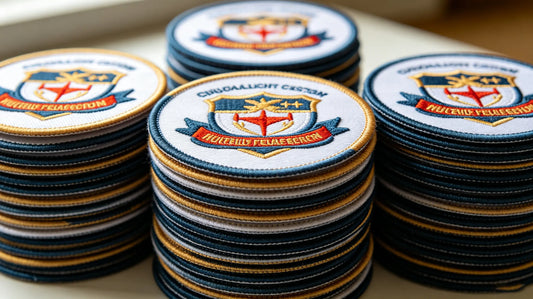
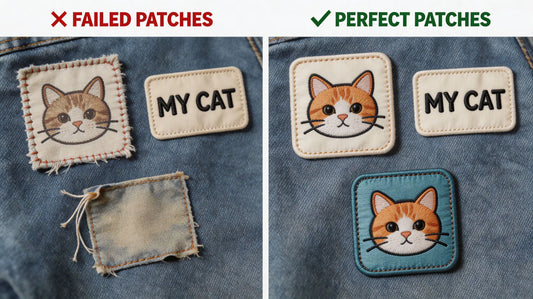
After sorting thousands of 2026 custom patch orders and customer feedback, we summarized the 10 most frequent and costly patch customization mistakes. This guide covers design errors, material mismatch, ordering pitfalls, and installation failures, providing targeted solutions for each problem. By avoiding these errors, you can get high-quality, perfect-matching, long-lasting custom patches every time. For error-free, high-standard customization, choose premium custom embroidered patches with professional one-on-one design support.
Whether you are ordering personal small-batch patches or team bulk orders, this practical guide can help you achieve zero-defect customization results.
1. Overly Tiny Text & Ultra-Complex Thin Lines (Causes Fuzzy Details)
The #1 design mistake beginners make is adding excessively small text and dense ultra-thin lines. Many users pursue exquisite and compact logos without considering the physical limitations of embroidery and weaving craftsmanship. In 2026, the industry standard minimum readable text size for embroidered patches is 4mm. Any text smaller than this will become blurred, stuck, or completely unrecognizable after production.
Complex overlapping thin lines and ultra-fine patterns also cause messy stitching and fuzzy edges. Unlike digital pictures, physical patches have stitching density limits. Trying to restore every tiny detail will only result in an unclear, chaotic final effect.
Solution: Enlarge tiny text properly and simplify redundant complex lines. Keep core logo elements and remove overly complicated decorative details. If your design requires ultra-high precision details, choose woven patches instead of standard embroidery. Professional design optimization ensures every custom embroidered patch presents clear and neat details.

2. Unreasonable Color Matching & Excessive Color Count
Many beginners pursue rich colors and stack multiple contrasting colors randomly, resulting in gaudy, uncoordinated patch styles that look inconsistent with clothing. In addition, excessive color types will increase production costs and extend production cycles. Each additional color requires separate thread replacement and color calibration, raising the risk of color difference.
Another common color mistake is ignoring fabric background color matching. A patch color that looks perfect on a white canvas may appear abrupt and inconsistent on dark or vibrant clothing.
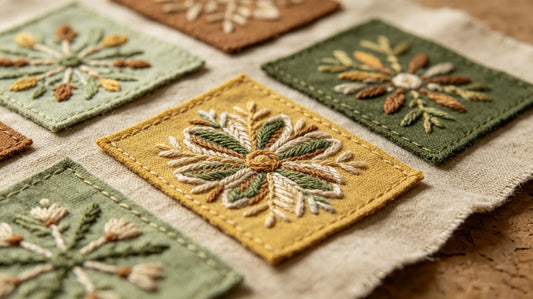
Solution: Control the color count within 6 colors for conventional patches. Adopt unified tone matching (Morandi low saturation, retro earth tone, or classic high-contrast black and gold) to ensure advanced visual effects. Confirm your clothing color in advance and adjust patch colors for better integration.
3. Wrong Material & Backing Selection (Leads to Mismatched Scenarios)
Most patch quality problems are not caused by poor craftsmanship, but by mismatched material and backing selection. Common errors include using iron-on patches for frequently washed work uniforms, adopting thick PVC patches for thin close-fitting T-shirts, and choosing velcro patches for formal business outfits.
Material mismatch will cause a series of problems: iron-on patches peel after multiple washes, PVC patches bulge and affect wearing comfort, and velcro patches destroy the sleekness of formal uniforms.
Solution: Match materials according to usage scenarios. Choose sew-on backing for long-term high-frequency washing uniforms, iron-on backing for daily casual DIY, PVC for outdoor tactical gear, and woven patches for thin fabric high-precision logos. Reasonable matching maximizes the service life and aesthetics of custom embroidered patches.

4. Ignoring Digital Proof Confirmation (Risk of Full-Batch Errors)
Many customers rush to start production without carefully checking digital mockups. Tiny errors such as spelling mistakes, wrong sizes, offset patterns, and incorrect border styles often exist in initial drafts. Skipping proof confirmation will lead to full-batch defective products, which cannot be modified after mass production.
This mistake is the most costly for bulk orders of teams and brands, often causing large-scale rework, delivery delays, and economic losses.
Solution: Treat the digital mockup as the final finished product. Carefully check text content, spelling, size proportion, color display, border shape, and pattern details. Only confirm production after 100% verification. Reliable suppliers provide free multiple revisions to ensure zero errors before producing embroidered patches.
5. Unilateral Pursuit of Low Price (Falling Into Low-Quality Trap)
In 2026, many unprofessional suppliers attract customers with ultra-low unit prices, but cut corners on embroidery density, thread quality, adhesive materials, and inspection processes. Low-cost patches usually have sparse stitching, easy-fading threads, weak adhesion, and rough edges.
Buyers who only focus on low prices often end up with defective patches that need reordering, resulting in higher comprehensive costs than high-quality customized products.
Solution: Focus on cost performance rather than single low price. Confirm embroidery density, color-fast thread material, free revision policy, and batch quality inspection standards. Formal manufacturers have transparent pricing and stable quality, avoiding secondary rework costs.

6. Unreasonable Size Setting (Too Large or Too Small)
Improper patch size is a common aesthetic mistake. Overly large patches will crowd the clothing visual space, making the outfit cumbersome and exaggerated. Overly small patches will lack decorative recognition, failing to display logo and design details effectively.
Many buyers set sizes randomly without combining actual clothing proportions, resulting in uncoordinated overall wearing effects.
Solution: Follow scenario size standards. Jacket back patches: 9–12cm; chest logo patches: 5–7cm; hat and cuff mini patches: 2–4cm. Match the size according to the clothing area to ensure balanced and harmonious visual effects of custom patches.
7. Neglecting Edge Border Design (Causes Curling & Fraying)
Some users pursue borderless designs or ignore border reinforcement for personalized styles. However, unbordered patches and poorly trimmed edges are prone to thread fraying, edge curling, and deformation after washing and friction, seriously affecting the service life and aesthetics of patches.
Solution: Choose professional laser cutting and merrow border technology. Complete border wrapping can fix the patch shape, prevent thread loosening, and maintain long-term flat and neat appearance. High-quality border craftsmanship is the basic guarantee for durable custom embroidered patches.

8. Blindly Choosing 3D Puff Embroidery (Unnecessary Cost Waste)
3D puff embroidery has a strong three-dimensional sense and high-end texture, but it is not suitable for all designs. Many beginners blindly upgrade to 3D craftsmanship for flat and simple logos, resulting in bloated patch appearance, inconsistent proportions, and unnecessary cost increases.
Small-sized patches and fine-texture logos are not suitable for 3D puff technology, which will cover original delicate details and make the pattern bulky.
Solution: Choose 3D puff embroidery only for large-area, simple, and stylish pattern designs. For delicate logos, tiny text, and small-size patches, flat high-density embroidery is more suitable, with a neater and more refined effect and higher cost performance.
9. Unreasonable Installation Operation (Causes Peeling & Bubbling)
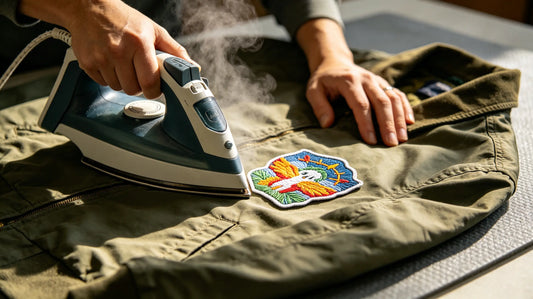
Even high-quality custom patches will fail due to wrong installation. Common installation mistakes include using steam iron for iron-on patches, insufficient pressing time, no natural cooling, pasting on dirty fabric surfaces, and high-temperature drying after installation.
These wrong operations directly lead to patch bubbling, edge warping, peeling, and weak adhesion, making users mistakenly believe that the patch quality is unqualified.
Solution: Follow standard installation steps: turn off steam, control temperature reasonably, use isolation cloth, press evenly, and cool naturally. Clean and flatten the fabric before installation to ensure tight adhesion between patches and clothing.

10. Ignoring After-Sales & Inspection Standards (Missing Rework Opportunities)
Many buyers do not check the batch quality after receiving the goods and ignore minor defects such as individual fuzzy threads, tiny color difference, and incomplete trimming. After wearing and washing, small problems gradually expand and cannot be repaired.
In addition, some buyers fail to confirm the supplier’s after-sales policy in advance, resulting in no guarantee for defective products and unable to enjoy free rework services.
Solution: Inspect patch quality one by one after receiving the order, check stitching neatness, color uniformity, edge smoothness, and adhesion firmness. Cooperate with suppliers with complete after-sales guarantee policies to ensure free rework for qualified defective products.
2026 Custom Patch Zero-Error Customization Checklist
✅ Optimize tiny text and complex lines to avoid fuzzy details ✅ Control reasonable color count and harmonious color matching ✅ Match material and backing according to actual usage scenarios ✅ Carefully verify digital mockup details before production ✅ Prioritize cost performance rather than ultra-low price ✅ Set patch size based on clothing proportion and scenario ✅ Adopt complete border reinforcement to prevent fraying and curling ✅ Select 3D/flat embroidery according to design characteristics ✅ Operate installation in strict accordance with standard steps ✅ Complete full quality inspection after receiving finished patches
Final Thoughts
Most custom patch failures are caused by avoidable small mistakes in design, selection, ordering, and installation, rather than technical defects. In 2026, high-quality patch customization relies on standardized processes and professional detail control. By avoiding the above 10 common mistakes, you can completely eliminate problems such as fuzzy details, peeling edges, color mismatch, cost waste, and batch defects.
Whether you are new to patch customization or a long-term bulk procurement buyer, mastering these error-avoiding skills can greatly improve customization efficiency and product quality. Choosing professional and standardized custom embroidered patches and matching correct customization methods is the key to obtaining perfect long-lasting decorative effects.
FAQ
Q:Why do my custom patches always look blurry?
A:Blurry patches are mainly caused by overly small text, ultra-complex thin lines, and unreasonable design density. Simplifying fine details and enlarging tiny text can effectively solve blurriness. You can get clear and neat customized works by ordering professional custom embroidered patches.
Q:What is the most common mistake in custom patch ordering?
A:The most common mistake is skipping digital proof confirmation, which easily leads to spelling errors, size deviation, and full-batch defective products. Wrong material and backing selection is another frequent error affecting patch durability.
Q:Are 3D puff patches suitable for all custom designs?
A:No. 3D puff embroidery is only suitable for large-area, simple, and stylish patterns. It is not recommended for small-size patches and designs with delicate text and fine lines, which will cause bloated and unclear details.
Q:How to avoid peeling and bubbling of iron-on patches?
A:Avoid steam ironing, control correct temperature and pressing time, use isolation cloth, and allow natural cooling and curing after ironing. Clean and flatten the fabric surface before installation to ensure tight adhesion.
Q:How to make custom patches look more high-end in 2026?
A:Optimize design simplicity, adopt low-saturation advanced color matching, choose suitable craftsmanship and size, and match correct backing materials. Neat border processing and uniform high-density stitching also greatly improve the premium texture of patches.
Tags:
Previous
How to Apply & Care for Iron-On Patches: Ultimate Step-by-Step Guide 2026
Next
Bulk Custom Patches Ordering Guide 2026 | Save Cost & Avoid Bulk Order Mistakes