How to Apply & Care for Iron-On Patches: Ultimate Step-by-Step Guide 2026
Iron-on patches are one of the most popular, convenient, and cost-effective customization solutions in 2026. Compared with sew-on and velcro patches, iron-on styles require no professional tools or sewing skills, allowing anyone to quickly decorate jackets, jeans, hats, backpacks, and uniforms at home. Despite their simplicity, most patch peeling, edge lifting, blistering, and short lifespan issues stem from incorrect application and improper daily care, rather than low-quality patch production.
Even premium custom patches will fail to stay in place if installed incorrectly. Mastering standardized iron-on application steps and scientific maintenance methods can greatly extend the service life of your patches, keeping them flat, firm, and vibrant for years. If you want to get stable and long-lasting decorative effects from your customized designs, starting with high-quality custom embroidered patches with durable iron-on backing is the first step to perfect DIY decoration.
This 2026 ultimate guide covers pre-application preparation, step-by-step ironing operations, fabric adaptation rules, common mistake fixes, and daily maintenance tips, solving almost all troubles related to iron-on patch installation and upkeep.
1. Pre-Application Preparation: Avoid Basic Failure Risks
Many iron-on patch failures start before the actual ironing process. Complete pre-preparation can eliminate 60% of common peeling and adhesion problems. First, confirm fabric compatibility. Iron-on patches are suitable for most cotton, denim, polyester, and blended conventional fabrics. However, they are not applicable for heat-sensitive materials such as nylon thin silk, waterproof coated fabrics, and elastic spandex cloth, which are prone to scalding, shrinkage, and coating damage under high temperature.
Second, clean the attachment area thoroughly. Dust, oil stains, sweat residues, and fabric wrinkles will create gaps between the patch adhesive and clothing, resulting in weak adhesion and edge warping. It is necessary to wash and dry the clothes in advance, then flatten the target position to ensure a smooth, dry, and clean bonding surface.
Third, prepare auxiliary tools: a household flat iron, a clean thin cotton cloth (or parchment paper), and a flat heat-resistant pad. Avoid using steam iron mode throughout the process, as water vapor will dilute the hot melt adhesive and cause insufficient sticking force. Standard prepping procedures ensure that every embroidered patch adheres perfectly to the fabric surface.

2. Standard Step-by-Step Iron-On Application Process
Follow this professional 2026 standard operation process to achieve zero-bubble, fully-flat, long-term firm adhesion for all iron-on custom patches:
Step 1: Adjust the iron temperature
Turn off the steam function of the iron, adjust the temperature to medium-high heat (150°C–180°C), and preheat for 3–5 minutes to ensure stable and even heat output. Different fabrics correspond to slightly different temperature ranges; cotton and denim can bear higher heat, while pure polyester needs slightly lower temperature to prevent scalding.
Step 2: Fix the patch position
Tear off the protective plastic film on the back of the iron-on patch, place the patch flat on the predetermined position with the pattern facing up, and slightly smooth the edges to avoid offset and wrinkles. Do not move the patch randomly after placement to prevent position deviation.
Step 3: Heat press with isolation cloth
Cover the patch and clothing surface with a clean thin cotton cloth or special ironing paper to prevent high-temperature direct scalding of patch threads and fabric. Press the iron firmly on the patch, keep uniform downward pressure, and iron back and forth for 10–15 seconds for small patches and 20–30 seconds for large patches.
Step 4: Press the reverse side for reinforcement
Turn the clothes over, aim the iron at the back of the patch position, and iron repeatedly for another 10–20 seconds to heat the bottom adhesive layer fully. Reverse ironing can effectively enhance the adhesion of the patch edge and avoid local virtual sticking.
Step 5: Cool and fix naturally
This is the most critical and easily ignored step. Do not touch or pull the patch immediately after ironing. Let it stand naturally for 10–20 minutes until the hot melt adhesive is completely cooled and cured. Only after full cooling can the adhesive reach the strongest bonding state. Patches cooled and fixed in strict accordance with the rules can maintain long-term firmness without falling off.
3. Key Rules for Different Fabric Types
Single ironing temperature and time cannot adapt to all fabrics. Targeted adjustment according to material characteristics is the core of successful patch installation. For thick denim, canvas, and jacket fabrics, high temperature and prolonged pressing can be adopted to ensure sufficient adhesive melting, very suitable for decorating custom embroidered patches on casual outerwear.
For ordinary cotton T-shirts and hoodies, medium temperature and standard pressing time are enough to balance adhesion and fabric safety. For thin polyester fabrics, low-medium temperature and shortened ironing time are required, with isolation cloth strictly used to avoid fabric shrinkage and damage. For special fabrics such as wool and knitted textures, reduce ironing frequency appropriately and increase natural cooling time to protect fabric elasticity.

4. Common Iron-On Patch Mistakes & Quick Fixes
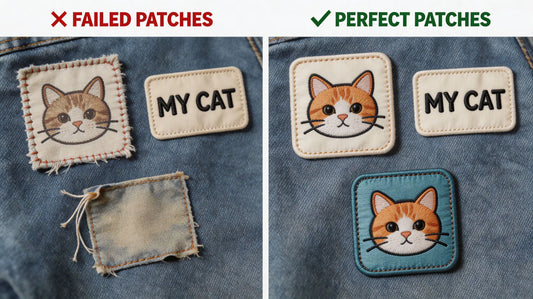
Most DIY users encounter patch edge warping, partial peeling, and bubble bulging problems. Here are the high-frequency mistakes and effective solutions:
Mistake 1: Bubbles appear on the patch surface
Cause: Excessive ironing temperature or too fast pressing speed traps air between the patch and the fabric. Solution: Puncture small bubbles gently with a fine needle, then cover with isolation cloth and iron with even pressure to exhaust air and flatten the patch.
Mistake 2: Edge warping and peeling after washing
Cause: Insufficient edge pressing and incomplete adhesive curing. Solution: Re-iron the warped area with local focused heating, strengthen edge pressing, and extend cooling time. For severely peeled patches, you can add a small amount of fabric glue for auxiliary reinforcement.
Mistake 3: Patch offset and pattern distortion
Cause: Moving the patch during hot ironing before adhesive curing. Solution: Fix the position in advance, avoid moving during operation, and strictly cool and shape statically.
5. 2026 Ultimate Iron-On Patch Care & Maintenance Guide
Correct installation determines the initial firmness, while scientific maintenance determines the long-term service life of the patches. To keep your iron-on custom patches bright and firm for a long time, follow these daily care rules:
Cold water gentle washing only: Avoid hot water soaking and high-temperature machine washing. Hot water will remelt the hot melt adhesive and cause peeling. Always use cold water and gentle mode for cleaning clothes with iron-on patches.
Avoid violent tumble drying: High-temperature dryer baking will accelerate adhesive aging and thread fading. It is recommended to choose natural shade air drying to protect patch texture and adhesion.
Prohibit bleach and strong detergent: Corrosive cleaning products will damage embroidery thread color and adhesive activity, leading to fading, whitening, and peeling. Use only neutral mild detergent for daily cleaning.
Reduce frequent friction: Avoid long-term extrusion and friction of backpacks and belts on patch positions. Reducing external force pulling can effectively prolong the service life of embroidered patches.

6. Is Iron-On Backing Suitable for You?
Iron-on backing is the best choice for users who pursue convenient installation, zero cost, and fast DIY decoration. It is perfect for daily casual clothes, personalized jackets, student uniforms, and short-term event costumes. However, for clothing that needs frequent washing, long-term wearing, and high-strength friction, sew-on backing and velcro backing are more durable and stable.
When customizing patches, you can freely match the most suitable backing according to your usage habits and scenario needs. Reasonable backing selection plus standardized installation and maintenance can maximize the cost performance of custom patches.

Final Thoughts
Iron-on patch installation and maintenance seem simple, but every detail determines the final wearing effect and service life. Unreasonable temperature control, incomplete cooling and curing, unclean bonding surface, and incorrect washing habits are the main causes of patch failure. By following the 2026 standardized step-by-step application process and daily maintenance rules, you can easily achieve long-term firm adhesion without peeling, bubbling, or fading.
Whether you are a personal DIY enthusiast or a team bulk customization buyer, mastering iron-on patch operation skills can help you give full play to the decorative value of custom patches. Choosing high-quality patches and matching scientific installation methods is the key to perfect personalized clothing decoration.

FAQ
Q:How long do iron-on patches last?
A:With correct installation and proper cold water maintenance, high-quality iron-on patches can last for years of daily wearing and repeated washing. Standard application and care greatly extend durability for premium custom embroidered patches.
Q:Why do my iron-on patches keep falling off?
A:Common reasons include insufficient ironing temperature and pressure, no natural cooling curing, dirty bonding surface, hot water washing, and steam iron usage. Reinstalling following standard steps can solve peeling issues effectively.
Q:Can I iron patches on polyester and thin clothes?
A:Yes, but you need to lower the iron temperature, use an isolation cloth, and shorten ironing time to avoid fabric shrinkage and scalding damage. Avoid high-temperature operation on all heat-sensitive fabrics.
Q:Can I machine wash clothes with iron-on patches?
A:Absolutely. Use cold water, gentle washing mode, and avoid tumble drying and bleach. Correct machine washing will not affect the firmness of well-installed iron-on patches.
Q:How to fix bubbled or warped iron-on patches?
A:Smooth out bubbles by venting air, cover with a cotton cloth, re-iron evenly, and fully cool naturally. Slightly warped edges can be reinforced with targeted secondary hot pressing for tight adhesion.
Tags:
Previous
Embroidered vs Woven vs PVC Patches: Which Is Best for Your 2026 Project?
Next
10 Common Custom Patch Mistakes to Avoid in 2026 | Complete Beginner’s Guide