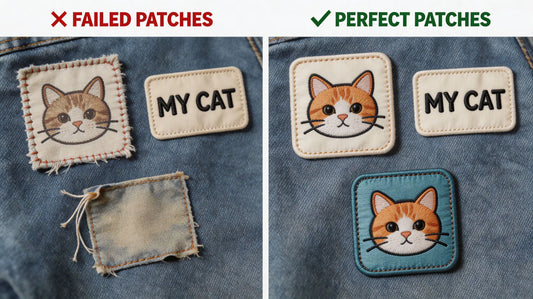
12 Common Custom Embroidered Patch Mistakes & Practical Fixes for Perfect Results
Custom embroidered patch customization seems straightforward, but countless small details determine the final finished quality. Many customers encounter disappointing results after waiting for production: blurry tiny text, peeling edges, dull colors, deformed shapes, stiff texture, or patterns that do not match the design draft. Most patch failures are not caused by poor factory craftsmanship, but by avoidable mistakes in early design, parameter setting, material selection, and requirement communication. Whether you order personal DIY patches, team bulk uniforms, or brand promotional merchandise, recognizing these common errors and corresponding fixes can save you time, budget, and rework costs. Before you order custom embroidered patches, master these mistake avoidance tips to ensure 100% satisfactory finished products.
After sorting out thousands of custom patch feedback and after-sales cases, we summarize 12 most frequent and typical customization mistakes, covering design, size, color, backing, craftsmanship, and post-production usage. Each mistake is equipped with targeted practical solutions and preventive measures, helping both novice and bulk professional buyers avoid all kinds of patch customization pitfalls.
1. Overly Small Text & Fine Line Design
This is the most common design mistake in custom patch production. Many customers pursue ultra-delicate details and design tiny text, thin lines, and mini logos on limited patch sizes. However, embroidery threads have physical thickness limits. Excessively small fonts and dense fine lines cannot be accurately presented by machine embroidery, resulting in blurred text, stuck lines, and unrecognizable patterns.
Mistake Performance: Tiny letters stick together, line details disappear, logo edges are fuzzy, overall pattern looks messy and undefined. Practical Fix & Standard: Keep English font size above 6mm and Chinese font size above 8mm. Avoid continuous ultra-thin lines thinner than 0.8mm. Simplify redundant tiny details appropriately and replace fine line patterns with bold blocks to ensure clear embroidery presentation. Prevention Tip: When designing, reserve detail space according to actual patch size, and do not blindly stack delicate elements on small-sized patches.
Pro Tip: When you custom embroidered patches with text elements, follow the minimum font size standard to guarantee clear and readable finished text.

2. Unreasonable Patch Size & Proportion Matching
Improper size setting will directly affect the wearing effect and practicality. Common problems include oversized patches causing clothing wrinkling, undersized patches making patterns inconspicuous, and inconsistent proportion leading to uncoordinated visual effects. Many buyers only focus on pattern design and ignore the matching between patch size and clothing carrier.
Mistake Performance: Large patches on hats cause edge warping; super small patches on jackets lack a sense of presence; square patterns are forcibly stretched into irregular proportions. Practical Fix & Standard: Match exclusive size ranges for different carriers: 5–7cm for hat patches, 8–10cm for jacket chest patches, 10–12cm for back large patches, 4–6cm for sleeve patches. Lock pattern proportion to avoid arbitrary stretching and deformation. Prevention Tip: Confirm the wearing position and clothing type first, then determine the patch size, instead of designing the pattern before setting the size.
3. Insufficient Color Contrast Leading to Blurred Patterns
Color matching errors are the main cause of low-grade patch appearance. Many customers choose similar colors for patch patterns and clothing backgrounds, or use too many similar low-contrast colors inside the patch, resulting in layered chaos and integrated patterns, losing visual recognition.
Mistake Performance: Patch blends with the clothes background, pattern edges are unclear, color layers are chaotic, the whole patch looks dull and not three-dimensional. Practical Fix & Standard: Ensure obvious brightness or hue difference between the main pattern, outline color, and background fabric. Add high-contrast black, white, or metallic outline borders for low-contrast color schemes to separate color blocks and enhance layering. Control the total number of colors within 3–5 to avoid messy color stacking. Prevention Tip: Simulate the actual wearing background color during design, and preview the contrast effect in advance.
Pro Tip: When you custom patches for multi-scene use, adopt neutral outline universal color schemes to adapt to different fabric backgrounds.

4. Blind Use of 3D Puff & Special Craft
Many customers blindly upgrade 3D puff, metallic, and glow-in-the-dark crafts for better-looking effects without combining pattern characteristics, resulting in counterproductive finished effects. Special crafts have strict pattern adaptability, and unreasonable use will destroy pattern details and texture.
Mistake Performance: 3D puff on small text causes font extrusion and blurring; full-patch metallic embroidery leads to crowded lines and dull luster; large-area luminous threads on fine patterns result in dim glow. Practical Fix & Standard: 3D puff is only suitable for bold large patterns and letter blocks, not for fine text and tiny details. Metallic threads are used for partial border and text embellishment instead of full filling. Luminous threads prioritize large-area solid color blocks. Prevention Tip: Match corresponding crafts according to pattern characteristics instead of blind universal upgrading.
5. Wrong Backing Selection Mismatching Usage Scenarios
Different patch backings (iron-on, sew-on, hook & loop) have completely different applicable scenarios and durability. Many buyers choose backings blindly, causing inconvenient pasting, easy falling off, or poor washing resistance, which seriously affects daily use.
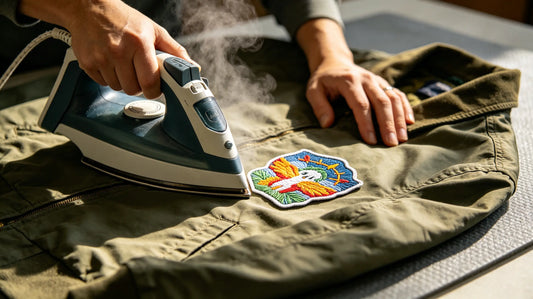
Mistake Performance: Iron-on patches fall off after one washing; hook & loop patches cannot be fixed closely on thin clothes; sew-on patches are chosen for disposable event merchandise resulting in cost waste. Practical Fix & Standard: Iron-on backing for low-frequency wearing and non-frequent washing decorations; sew-on backing for long-term wearing and high-frequency washing uniforms; hook & loop backing for replaceable tactical and decorative patches. Prevention Tip: Confirm washing frequency and wearing cycle first, then select the most cost-effective backing type.
Pro Tip: When you order custom embroidered patches for work uniforms that need frequent cleaning, prioritize durable sew-on backing.

6. Ignoring Edge Cutting & Border Processing
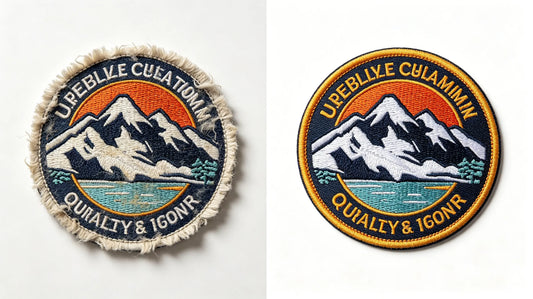
Patch edge processing determines the neatness and durability of the finished product. Many low-quality custom patches have untrimmed burrs, uneven edges, and unclosed borders, which are not only unsightly but also easy to loose threads and warp after washing.
Mistake Performance: Patch edges have floating threads and burrs; irregular cutting shapes; edge warping after washing; thread falling off at the corners. Practical Fix & Standard: Adopt laser precise cutting for neat and smooth edges. Add fully closed embroidered borders for all irregular patches to lock threads and prevent loose edges. Avoid open border designs for daily wearable patches. Prevention Tip: Require closed border craftsmanship for customized patches to improve overall durability and neatness.
7. Excessively Dense or Sparse Stitch Density
Stitch density is the core parameter affecting patch texture. Too sparse stitching leads to exposed bottom cloth, faint patterns, and easy deformation; too dense stitching causes hard patch texture, thread extrusion, crowded lines, and easy breakage.
Mistake Performance: Sparse stitching sees bottom fabric, pattern color is light and uneven; dense stitching makes the patch stiff and thick, lines are crowded and messy. Practical Fix & Standard: Adopt standard balanced stitch density (75%-100%) for conventional patches. 100% high-density stitching for dark and solid color patterns to ensure full color filling; 50%-75% sparse density for light and gradient patterns to avoid crowding. Prevention Tip: Avoid pursuing over-dense stitching blindly, and match density according to pattern area and color filling demand.

8. Unreasonable Color Expectation & Color Difference Misunderstanding
Many customers overestimate the color restoration ability of embroidery threads, thinking that electronic design draft colors can be 100% restored. In fact, physical embroidery threads have fixed color card ranges, and there are inevitable tiny color differences between screen display and physical objects. Unreasonable color expectations lead to dissatisfaction with finished products.
Mistake Performance: Physical patch color is different from the mobile phone/computer screen draft; gradient color restoration is not natural; bright colors are dimmer than expected. Practical Fix & Standard: Refer to the actual physical thread color card for design, not purely relying on screen colors. Explain gradient and transition color limitations in advance for complex color matching. Accept reasonable tiny color difference within the industry standard range. Prevention Tip: Confirm color card samples before bulk production to avoid large-area color deviation.
Pro Tip: When you custom embroidered patches with high color requirements, ask for pre-production color samples for confirmation.
9. Ignoring Fabric Adaptability & Hard Matching
Different clothing fabrics have different thickness, elasticity, and softness. Hardly matching thick and stiff patches on ultra-thin elastic clothes will cause clothing wrinkling, patch warping, and poor fitting, affecting wearing comfort and appearance.
Mistake Performance: Thick patches on thin t-shirts cause fabric wrinkling; hard patches on elastic clothes restrict stretching; patch edges lift and do not fit closely. Practical Fix & Standard: Match thin and soft backing and low-density embroidery for thin elastic fabrics; use conventional thickened patches for thick fabrics such as denim and canvas. Avoid oversized hard patches on lightweight clothes. Prevention Tip: Clarify the customized clothing fabric type in advance and adjust patch thickness and hardness accordingly.

10. Overlooking Washing & Maintenance Limitations
Many patch damage problems after use are caused by ignoring process maintenance limitations. Special crafts such as metallic threads, luminous threads, and 3D puff have strict washing and temperature restrictions. Random cleaning leads to thread breakage, luster loss, and luminous failure.
Mistake Performance: Metallic threads fade and break after washing; luminous patches lose luminous function after high-temperature ironing; 3D puff patches are flattened by high-temperature drying. Practical Fix & Standard: Form targeted maintenance schemes according to patch crafts. Avoid high temperature, strong detergent, and hard friction for special craft patches. Adopt cold water gentle washing and shade drying. Prevention Tip: Save professional maintenance guidelines after receiving customized patches to prolong service life.
11. Blind Bulk Order Without Sample Confirmation
Many bulk customers directly place large orders after confirming the design draft without physical sample confirmation. Once there are design defects, color deviation, or craftsmanship problems, the whole batch of products will be scrapped, causing huge budget loss and delivery delay.
Mistake Performance: Batch patches have unified detail defects; overall color deviation does not meet expectations; size and proportion are mismatched. Practical Fix & Standard: For bulk orders above 50 pieces, prioritize sample confirmation first. Check size, color, craftsmanship, and wearing effect of physical samples, and start mass production only after full confirmation. Prevention Tip: Sample inspection is the most effective way to avoid batch customization risks.
12. Copyright & Pattern Infringement Risks
Many novice buyers randomly download celebrity patterns, brand logos, and online original designs for customization without authorization, ignoring copyright and trademark infringement risks. Commercial use of unauthorized patterns will lead to order rejection and legal risks.
Mistake Performance: Custom orders are intercepted due to infringement; finished patches cannot be used commercially; face copyright dispute risks. Practical Fix & Standard: Prioritize original independent designs for customized patches. Do not use registered trademarks, celebrity portraits, and copyrighted works without official authorization. For commercial bulk orders, ensure pattern originality and compliance. Prevention Tip: Communicate with suppliers in advance to confirm pattern compliance and avoid infringement risks.
Key Standard Checklist for Flawless Custom Patches
To help you avoid all mistakes efficiently, we have sorted out a one-stop pre-order inspection checklist. Complete the following checks before placing an order to ensure zero-error customization: • Check text size: Font size meets the minimum embroidery standard without blurring risk • Check color contrast: Pattern and background have obvious layering with clear outlines • Check craft matching: Special crafts match pattern characteristics without blind upgrading • Check backing selection: Backing type matches wearing scenario and washing frequency • Check size proportion: Patch size fits clothing carrier and wearing position • Check border integrity: Irregular patches adopt closed border anti-loose thread design • Check pattern originality: No copyright or trademark infringement risks • Check sample confirmation: Complete physical sample verification for bulk orders
Final Thoughts
Most custom embroidered patch failures are avoidable human errors rather than craftsmanship problems. From ultra-small text design, unreasonable color contrast, and blind craft upgrading to mismatched backing selection and unconfirmed bulk samples, every detail error may affect the final finished effect. Mastering these 12 common mistakes and targeted fixes can help you eliminate customization risks fundamentally, greatly improve the success rate of customized patches, and save rework time and unnecessary cost waste.
High-quality custom patches rely on standardized design, reasonable parameter matching, strict pre-production inspection, and professional craftsmanship. Avoiding common customization pitfalls is the first step to getting perfect patches. When you are ready to order custom embroidered patches, follow this complete mistake avoidance guide to create flawless, high-quality, and cost-effective custom embroidered patches.
FAQ
Q:Why are the text on my custom embroidered patches blurry and stuck?
A:Blurry and stuck text is mainly caused by undersized fonts and over-dense fine lines. Embroidery threads have physical thickness limitations, and text smaller than 6mm cannot be clearly presented. The solution is to appropriately enlarge the font size, simplify tiny details, and replace dense fine lines with bold patterns. Follow the minimum text standard during design to ensure clear and readable finished text. When you custom embroidered patches, consult the design team for text size optimization suggestions.
Q:How to avoid patch color difference between design draft and finished product?
A:Screen color deviation is unavoidable due to different display device parameters. To reduce color difference, refer to the supplier’s physical thread color card for design instead of relying solely on electronic drafts. For high-precision color requirements, request pre-production color samples for confirmation. Tiny color differences within the industry standard range are normal and do not affect overall appearance.
Q:Is 3D puff embroidery suitable for small text and fine logos?
A:No, 3D puff embroidery is not suitable for ultra-fine text and tiny detailed patterns. The raised foam layer will squeeze small patterns and fonts, resulting in blurring and deformation. 3D puff crafts are only recommended for bold large-area patterns and letter blocks. Fine text and precise logos should adopt standard 2D flat embroidery for accurate restoration.
Q:Which backing type is the most durable for frequently washed uniforms?
A:Sew-on backing is the most durable option for high-frequency washing scenarios. It adopts physical stitching fixation with strong anti-falling and wash resistance, not easy to peel or deform after long-term repeated washing. Iron-on patches are easy to lose adhesion after multiple cleanings, while hook & loop patches are more suitable for replaceable decoration. When you custom patches for work uniforms and team apparel with frequent washing, choose sew-on backing preferentially.
Q:Do I need a sample confirmation before bulk patch orders?
A:Yes, sample confirmation is strongly recommended for all bulk orders. Physical samples can intuitively verify size, color, craftsmanship, texture, and wearing effect, effectively avoiding batch defects, color deviation, and detail errors. It is the most critical step to ensure zero-risk bulk customization and save unnecessary rework costs.
Tags:
Previous
Custom Embroidered Patch Color Matching Guide: Rules, Palettes & Mistakes to Avoid
Next
7 Hottest Custom Embroidered Patch Design Trends for 2026 (Ultimate Style Guide)