10 Common Custom Embroidered Patch Mistakes & How to Avoid Them (2026 Guide)
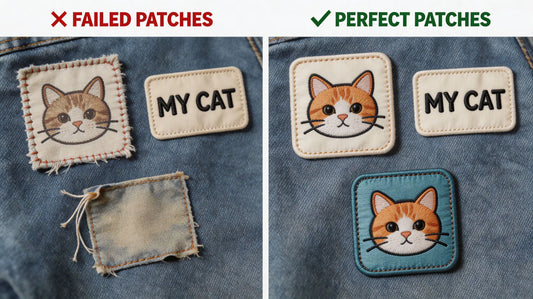
Custom embroidered patches seem simple to order, but most first-time buyers and even long-term bulk clients repeatedly make the same mistakes. Wrong sizes, mismatched backing, overcrowded designs, incorrect installation, and poor color choices often lead to blurry details, peeling edges, awkward proportions, and completely unusable final products. These errors waste money, delay project schedules, and ruin uniform styling, brand merchandise, and personalized DIY effects. Before you order custom embroidered patches, read this complete mistake guide. We have summarized the top 10 most frequent patch customization errors with targeted fixes to ensure flawless patch results every time.
Based on thousands of custom patch orders, after-sales feedback, and customer revision records, these 10 mistakes cover the entire customization process: pre-order design selection, parameter confirmation, backing matching, size setting, and post-receiving installation. Every mistake is equipped with practical and actionable solutions, suitable for personal custom DIY, team uniform bulk orders, and brand merchandise customization.
1. Choosing the Wrong Patch Backing for the Fabric
The most common and destructive mistake is blindly selecting backing types without matching the wearing fabric and usage scenario. Many customers randomly choose iron-on backing for frequent-wash uniforms or sew-on backing for temporary decorative patches, resulting in either poor durability or unnecessary cost waste.
Common Wrong Matches: Using iron-on patches on ultra-thin elastic clothes or high-frequency washed work uniforms causes rapid peeling and glue failure. Choosing fixed sew-on patches for tactical gear that requires frequent pattern replacement leads to zero flexibility. Adopting hook & loop backing on thin T-shirts creates bulky, uncomfortable wearing experience.
Professional Fix: Follow scenario-based matching rules. Iron-on backing for short-term daily decoration and thick conventional fabrics. Sew-on backing for long-term uniforms, special fabrics, and high-wear scenarios. Hook & loop backing for replaceable tactical, outdoor, and backpack patches. When youcustom patches, confirm your fabric type and washing frequency first to select the optimal backing.

2. Ordering Improper Patch Sizes (Too Big or Too Small)
Size mismatch ranks second in custom patch failures. Beginners often underestimate the actual patch size, resulting in tiny, unrecognizable logo patches or oversized, crowded patterns that destroy clothing proportion. Many also confuse centimeter and inch units, causing serious size deviation.
Typical Size Mistakes: 4cm ultra-small patches with tiny text that cannot display clear details; over 8cm oversized patches on hat curved surfaces causing warping; over 12cm large patches on slim T-shirts leading to fabric sagging and wrinkling; inconsistent sizes for team uniform batches causing messy overall styling.
Professional Fix: Follow our standard scene size rules. 5–6.5cm for hats, 7–10cm for chest uniforms, 5–7cm for sleeves, 10–15cm for back decorations. Always confirm unit dimensions and preview size simulation before mass production to avoid proportion imbalance.
3. Overcrowding Too Many Details in Small Patches
Excessive detail stacking on small-sized patches is a classic beginner mistake. Many customers pursue rich patterns and retain every tiny text, icon, and line on limited patch space. However, embroidery craftsmanship has technical limits. Too many details on small patches will cause blurry patterns, overlapping lines, and missing content after production.
Problem Performance: Tiny letters stick together, thin lines merge into blocks, complex icons lose outline layering, and the whole patch looks messy and unclear, seriously reducing texture and recognition.
Professional Fix: Simplify design details according to patch size. For patches below 7cm, remove redundant tiny text and trivial decorative lines, retain core logos and main patterns. For ultra-fine details that cannot be embroidered clearly, appropriately enlarge the patch size or adjust to partial printing + embroidery hybrid craft to restore details.

4. Ignoring Fabric Color & Background Contrast
Many customers only focus on patch pattern colors while ignoring the matching effect with the clothing background color. Low contrast between patches and fabrics leads to poor visual recognition, making elaborate custom designs lose decorative and identification value.
Typical Errors: Dark green or black patches on dark hoodies cause the pattern to blend into the background; light white or beige patches on light gray clothes lack layering; similar color matching makes team uniform logos unclear and unprofessional.
Professional Fix: Ensure obvious color contrast between patch main color and clothing background. Use high-brightness outline threads to border the pattern and enhance layering. For single-color dark or light clothes, adopt contrasting color schemes to highlight patch recognition and three-dimensional sense.
5. Neglecting Embroidery Density & Flatness Balance
Two extreme density mistakes often occur in customization: excessive pursuit of full stitching density leading to hard, thick patches, or over-pursuit of sparseness resulting in thin, hollow patterns. Unreasonable density directly affects patch texture, flatness, and wearing comfort.
Problem Performance: Overly dense patches are stiff, easy to wrinkle after pasting, and cause stuffy and uncomfortable wearing; overly sparse patches have exposed bottom cloth, incomplete pattern coverage, and cheap visual texture.
Professional Fix: Adopt standard balanced density (70%–85% coverage for ordinary patches). Full coverage for logo core patterns to ensure completeness, and sparse stitching for background blank areas to keep patches soft and flat. High-quality balanced density ensures both clear patterns and comfortable wearing.

6. Wrong Installation Method Destroying Perfect Patches
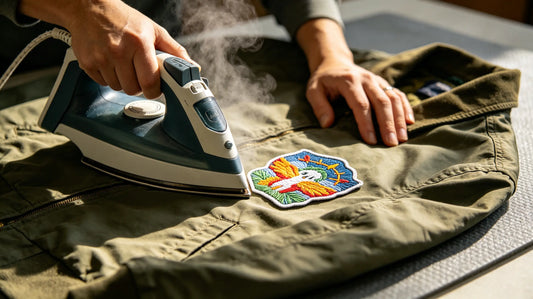
Many high-quality custom patches are damaged by incorrect installation. Unstandardized ironing temperature, uneven pressing, unclean pasting surfaces, and wrong operation sequences cause qualified patches to warp, bubble, peel, and deform after installation.
Common Installation Mistakes: High-temperature instantaneous ironing scalds threads and melts glue; uneven pressing leads to local hollowing and bubbles; pasting on dusty and wrinkled fabrics causes poor fitting; ironing 3D puff patches directly flattens three-dimensional stereo effect.
Professional Fix: Clean and smooth the fabric before installation. Control medium temperature (110–150°C) for iron-on patches, press evenly for 20–30 seconds with isolation cloth. Avoid direct high-temperature pressing on special craft patches. For bulk orders, follow professional installation tutorials to ensure uniform fitting effect.
7. Overlooking Edge Border Reinforcement
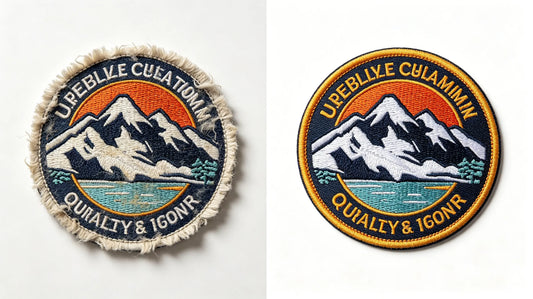
Edge processing determines the service life of patches. Many customers ignore border design and choose no-border or irregular simple edges, resulting in frequent edge fraying, thread loosening, and pattern delamination after slight friction and washing.
Problem Performance: Unbordered patches fray rapidly after washing; thin irregular edges crack and fall off; long-term wearing leads to large-area thread loss and pattern damage.
Professional Fix: Choose firm merrow border for most conventional patches, neat and wear-resistant. For special-shaped patches, adopt laser cutting and edge sealing technology to prevent fraying. Reasonable edge reinforcement can double the patch service life and maintain long-term neat appearance.

8. Unreasonable Color Matching & Excessive Color Stacking
Blindly stacking multiple colors in pursuit of rich layers is another common mistake. Excessive messy color matching makes patches gaudy and uncoordinated, lacking high-end texture, and increases the risk of color cross-staining during washing.
Typical Errors: More than 6 random colors in a single patch without tone coordination; mismatched warm and cold tones; excessive bright color stacking leading to visual clutter; inconsistent color tone of batch patches affecting team uniformity.
Professional Fix: Control single patch color within 3–5 main tones, maintain unified tone coordination. Prioritize low-saturation matching for daily and uniform patches, and high-contrast limited color stacking for trendy streetwear patches. Standard color grading ensures aesthetic and coordinated finished products.
9. Ignoring Washing & Maintenance Taboos
Even perfectly customized patches will be damaged quickly without correct maintenance. Most users ignore patch maintenance taboos, adopting universal washing and drying methods for all patches, leading to premature fading, peeling, and deformation.
Common Maintenance Mistakes: Machine washing iron-on patches at high temperature; exposing patches to direct sunlight for long drying; scrubbing special craft patches hard; washing hook & loop patches without detachment; random pulling of loose threads causing large-area damage.
Professional Fix: Classify maintenance by backing and craft. Cold water gentle washing for iron-on patches, detachable cleaning for hook & loop patches, low-temperature isolated ironing for embroidered patches, and cool ventilation drying to avoid sunlight exposure. Standard maintenance maintains patch brightness and firmness for years.

10. Blindly Pursuing Low Prices for Bulk Orders
For team and brand bulk customization, blindly pursuing ultra-low prices is the biggest hidden danger of defective patches. Low-cost cutting corners such as inferior threads, thin adhesive, low-density stitching, and rough edge processing lead to unstable batch quality and serious after-sales problems.
Problem Performance: Batch patches fade after one washing, edges fray in large areas, adhesive fails in batches, color deviation is serious, and pattern details are missing, causing huge losses for team uniform and brand merchandise customization.
Professional Fix: Prioritize cost performance rather than ultra-low prices for bulk orders. Confirm thread quality, backing material, stitching density, and edge processing technology before ordering. Reliable craftsmanship ensures batch consistency and long-term stability. When you order custom embroidered patches in bulk, focus on quality parameters to avoid after-sales losses.
Quick Checklist to Avoid All Patch Mistakes
Before confirming any custom patch order, check this 6-point quick checklist to eliminate all errors: 1. Confirm backing type matches fabric and usage frequency 2. Verify patch size fits the wearing position (hat/chest/sleeve/back) 3. Simplify excessive tiny details on small-size patches 4. Ensure obvious color contrast between patch and clothing background 5. Confirm edge merrow border or laser sealing reinforcement 6. Check color quantity and tone coordination to avoid messy matching
Final Thoughts
90% of custom embroidered patch failures are caused by avoidable human errors rather than craftsmanship problems. Wrong backing matching, inappropriate size, overcrowded details, poor color contrast, incorrect installation, and neglected maintenance will completely ruin customized effects. Mastering these 10 common mistakes and targeted fixing methods can help you avoid waste, save customization costs, and obtain high-quality, durable, and aesthetically perfect custom patches every time.
Whether it is personal DIY small-batch customization or team brand bulk orders, standardized parameter confirmation and reasonable design matching are the core of high-quality patch customization. When you prepare to custom embroidered patches, refer to this mistake avoidance guide to eliminate all hidden risks and get satisfactory finished patch products.
FAQ
Q:Why do my custom patches look blurry and unclear?
A:Blurry patches are mainly caused by overcrowded tiny details on small-size patches, insufficient embroidery density, and low-resolution design files. Too many fine lines and texts cannot be fully restored by embroidery technology, resulting in merged and fuzzy patterns. The solution is to simplify redundant details or appropriately enlarge the patch size. When you custom embroidered patches, optimize design details according to actual patch dimensions.
Q:What is the worst mistake for uniform patch customization?
A:The most serious uniform patch mistake is inconsistent size, color tone, and backing type in batches, which leads to messy overall team dressing and unprofessional appearance. Secondly, mismatched iron-on backing for frequently washed uniforms causes batch peeling. Unified specifications and reasonable backing selection are the core of uniform patch customization.
Q:Can I avoid patch fraying completely?
A:Yes. Choosing patches with merrow border or laser edge sealing technology can completely avoid edge fraying. Unbordered patches are prone to thread loosening and fraying after washing and friction. Reinforced edge processing is the most effective way to maintain patch integrity and long service life.
Q:Why do new iron-on patches keep peeling off?
A:New patch peeling is caused by incorrect installation: uneven ironing pressure, insufficient temperature, dusty fabric surface, or high-temperature machine washing immediately after pasting. Use medium temperature isolation ironing for 20–30 seconds and avoid violent washing within 24 hours after installation to ensure firm adhesion.
Q:How to match patch colors correctly for different clothes?
A:Follow the high-contrast matching principle. Light-colored clothes match dark high-saturation patches, and dark clothes match light bright patches. Use border lines to enhance layering for low-contrast color schemes. Control the total number of colors within 5 to avoid gaudy and messy visual effects. When you custom patches, ask the design team for professional color matching suggestions.
Tags:
Previous
Custom Embroidered Patches Care Guide: Wash, Fix & Maintain Long-Lasting Quality
Next
Embroidered vs Printed Patches: Which Is Better for Customization in 2026?