Custom Embroidered Patches Care Guide: Wash, Fix & Maintain Long-Lasting Quality
Custom embroidered patches are delicate decorative accessories that combine fine stitching, colored threads, and special backing materials. Even high-quality well-crafted patches will gradually fade, fray, peel, or warp without proper daily care and incorrect washing methods. Many users encounter common problems after wearing: bright colors turn dull, patch edges peel off, loose threads appear, and adhesive fails after washing. Most patch damage is not caused by poor craftsmanship, but improper daily maintenance. Mastering scientific washing, drying, ironing, and repair skills can greatly extend the service life of custom patches and keep them brand-new for years. Before you order custom embroidered patches, learn this full care guide to protect your customized works perfectly.
Different patch backings (iron-on, sew-on, hook & loop) and special crafts (3D puff, metallic thread, luminous thread) have exclusive maintenance rules. Universal washing methods are easy to cause secondary damage. Based on practical maintenance experience and craft characteristics, we have sorted out a full set of professional care solutions, covering daily cleaning, stain removal, damage repair, ironing skills, and long-term storage, suitable for all types of custom embroidered patches.
1. Universal Pre-Care Rules for All Embroidered Patches
Before any cleaning or maintenance operation, follow these universal basic rules to avoid irreversible patch damage. These principles apply to all backing types and embroidery crafts, being the foundation of patch long-term preservation.
Core Universal Rules: • Avoid high temperature: Most embroidery threads and adhesives are sensitive to heat; high temperature washing, drying, or ironing will cause fading, glue failure, and fabric shrinkage. • Reject strong chemicals: Never use bleach, strong alkaline detergent, or corrosive stain remover, which will damage thread color and fiber texture. • Prevent violent friction: Extrusion, rubbing, and twisting during cleaning will cause loose threads, edge fraying, and pattern deformation. • Classify washing: Separate dark and light patch clothes to avoid color cross-staining; wash special craft patches separately. • Check edges before cleaning: Trim tiny floating threads and reinforce slightly warped edges in advance to prevent further damage during washing.

2. Targeted Washing Methods by Patch Backing Type
The biggest mistake in patch maintenance is using unified washing methods for all backings. Iron-on, sew-on, and hook & loop patches have completely different water resistance and fixation stability, requiring targeted washing operations.
Iron-On Heat Seal Patches (Most Fragile)
Iron-on patches rely on hot-melt adhesive for fixation, with limited water resistance. Incorrect washing is the main cause of peeling and falling off.
Correct Washing Steps: Adopt cold water hand washing as the priority, water temperature controlled below 30°C. Use only neutral mild detergent, fully dissolve the lotion before putting in the clothes. Gently press and clean the fabric around the patch, avoid rubbing the patch surface hard. Rinse thoroughly to remove residual detergent, prevent chemical residue from corroding the adhesive layer and causing fading. Do not soak for more than 10 minutes, long-time soaking will weaken the adhesive viscosity.
Prohibited Operations: No machine washing, no high-temperature water washing, no hard scrubbing, no soaking for a long time. Avoid tumble drying and high-temperature ironing on the patch surface.
Sew-On Patches (Most Durable)
Sew-on patches are fixed by physical stitching, with excellent wash resistance and durability, supporting daily conventional cleaning.
Correct Washing Steps: Hand wash or gentle machine wash are both available. Use cold water or low-temperature warm water below 40°C, match neutral detergent. For heavily stained areas, gently brush with a soft-bristled brush instead of hard rubbing. It can withstand normal repeated washing without peeling or deformation.
Maintenance Tips: Check the edge stitching regularly, trim loose floating threads in time to prevent thread spreading and edge fraying.
Hook & Loop Removable Patches
Hook & loop patches have detachable characteristics, which is the key to maintenance. The velcro structure is easy to stick fluff and sundries, affecting adhesion and aesthetics.
Correct Washing Steps: Detach the patch completely before washing clothes, do not wash the patch and clothes together. Clean the velcro surface regularly, use tweezers or sticky roller to remove stuck fluff, hair, and debris. The fixed loop base on the clothes can be washed normally with gentle modes.
Pro Tip: Detaching before washing can effectively extend the service life of hook & loop patches and maintain strong adhesion. When you custom embroidered patches for tactical gear, master this detachable washing rule to keep patches in perfect condition.
3. Special Craft Patch Maintenance Rules
3D puff, metallic thread, luminous thread, and chenille patches have special material structures, which are more fragile than ordinary flat embroidery and need exclusive protective maintenance.
3D Puff Patches: Avoid high temperature extrusion and heavy pressing. High heat will flatten the foam layer and destroy the three-dimensional effect. Do not scrub hard on the raised parts, clean gently by pressing to prevent foam layer damage and thread falling off.
Metallic Thread & Shiny Patches: Metal threads are easy to oxidize and fade. Strictly prohibit bleach and strong detergent. Reduce washing frequency appropriately, avoid long-time water soaking, and prevent metallic luster from darkening and disappearing.
Luminous & Reflective Patches: Do not expose to strong sunlight for a long time, ultraviolet rays will weaken the luminous and reflective effect. Avoid hard friction on the functional coating to prevent coating peeling and failure.
Chenille Plush Patches: Prevent excessive water soaking and hard scrubbing, which will cause plush matting and deformation. Dry in a ventilated place after washing, and comb the plush gently with a small comb to restore fluffy texture.

4. Scientific Drying & Ironing Skills (Avoid Deformation & Peeling)
Unreasonable drying and ironing are the hidden culprits of patch damage. Many intact patches are scrapped due to improper high-temperature drying and wrong ironing operations.
Standard Drying Methods: • All embroidered patches prohibit high-temperature tumble drying and direct high-temperature baking. • After washing, squeeze out excess water gently, do not twist or wring the patch position. • Turn the clothes inside out, hang in a cool and ventilated place for natural air drying, avoid long-time direct sunlight exposure to prevent color fading and fabric aging. • For thick patches, flatten the edges manually before drying to avoid warping and curling after drying.
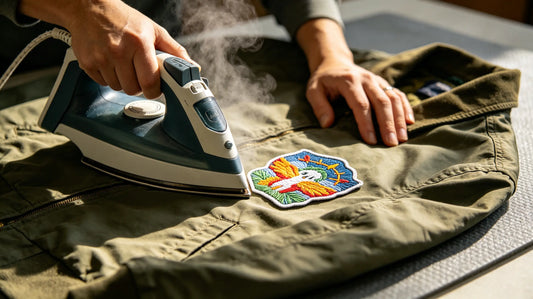
Safe Ironing Guidelines: • Ironing is allowed only after the clothes are completely dry. • Must iron on the reverse side of the clothes or use a thin cotton cloth as isolation, do not iron the patch surface directly. • Control iron temperature at low to medium heat (110°C-150°C), prohibit high-temperature ironing. • For 3D puff and plush patches, avoid ironing the raised parts to prevent flattening and texture damage. • Iron edge positions slightly to smooth warped edges and fit the patch more closely.
Pro Tip: Correct ironing can repair slight edge warping. When you custom patches with special textures, strictly follow low-temperature isolated ironing rules.
5. Common Patch Damage Quick Repair Solutions
Slight damage such as peeling, fraying, and fading during use does not require patch replacement. Master these simple repair methods to restore patch integrity easily.
Peeling & Lifting Edges (Iron-On Patches): Clean the patch surface and clothes gap, remove dust and sundries. Cover with a thin cotton cloth, press and iron at medium temperature for 20-30 seconds, then press cold for shaping. The hot-melt adhesive will re-bond firmly, solving edge warping and peeling problems.
Loose Threads & Fraying Edges: Do not pull the loose threads hard. Use small scissors to trim excess floating threads neatly. For slight edge fraying, apply a tiny amount of fabric glue on the edge or perform simple hand stitching reinforcement to prevent continuous fraying.
Slight Fading & Dullness: Avoid repeated strong cleaning. Use color fixing detergent for auxiliary cleaning during subsequent washing. Store in dark and dry environment when not in use to reduce light aging and restore partial color brightness.
Weak Velcro Adhesion (Hook & Loop): Thoroughly clean the fluff and debris on the velcro surface. If the adhesion is severely weakened, replace the new hook & loop base to restore flexible disassembly and fixation.

6. Long-Term Storage & Daily Protection Tips
Good daily protection and storage habits can effectively delay patch aging and maintain long-term new texture, suitable for collection-level custom patches and commemorative patch preservation.
Daily Wearing Protection: Avoid long-term friction with backpacks, belts, and hard objects during wearing. Prevent sharp objects from scratching the embroidery surface to avoid thread hooking and pattern damage. Take off clothes gently to avoid pulling the patch edges violently.
Long-Term Storage Rules: Clean and dry the clothes completely before storage. Fold or hang flat, avoid heavy pressing and long-time extrusion. Store in a dry, cool, and ventilated environment, away from humid and high-temperature places to prevent mildew, adhesive failure, and thread oxidation fading. Do not store with corrosive chemicals.
7. Taboo Summary: 7 Behaviors That Destroy Embroidered Patches
Avoid these wrong operations completely to eliminate most patch damage problems fundamentally: • High-temperature boiling water washing and high-temperature tumble drying • Using bleach, strong alkaline detergent, and corrosive stain remover • Hard rubbing, twisting, and violent machine washing for iron-on patches • Direct high-temperature ironing on patch surface and special craft textures • Long-time sunlight exposure leading to fading and aging • Washing hook & loop patches without detachment • Pulling loose threads randomly causing large-area thread falling off

Final Thoughts
The service life and appearance retention of custom embroidered patches depend 50% on production craftsmanship and 50% on daily maintenance. Different backing types and special crafts have targeted care rules. Blind universal cleaning methods will lead to peeling, fading, deformation, and texture damage. Mastering scientific cold water washing, isolated low-temperature ironing, classified maintenance, and timely minor repair skills can maximize the service life of custom patches, keeping the patterns bright, edges neat, and fixation firm for a long time.
Whether it is daily decorative patches, long-term worn uniform patches, or collectible customized commemorative patches, standardized maintenance is the key to maintaining their texture and value. When you are ready to order custom embroidered patches, save this professional care guide to protect your customized works and avoid unnecessary damage and re-customization costs.

FAQ
Q:Can embroidered patches be machine washed?
A:It depends on the patch backing. Sew-on patches support gentle machine washing. Iron-on patches are not recommended for machine washing, as violent stirring will cause adhesive failure and peeling. Hook & loop patches must be detached before machine washing. It is always the safest choice to wash embroidered patches by hand with cold water. When you custom embroidered patches, we suggest prioritizing sew-on backing for frequently machine-washed apparel.
Q:How to fix peeling iron-on patch edges?
A:Clean the gap between the patch and fabric to remove dust, cover the patch with a thin cotton cloth, then iron at medium temperature for 20-30 seconds and press cold to shape. This can reactivate the hot-melt adhesive and firmly bond the warped edges. Avoid high-temperature ironing directly on the patch surface to prevent pattern damage.
Q:Why do embroidered patches fade after washing?
A:Patch fading is mainly caused by high-temperature washing, strong chemical detergents, long-time sunlight exposure, and excessive friction. To prevent fading, use cold water and neutral mild detergent, avoid bleach, and dry in a cool ventilated place away from direct sunlight.
Q:Can 3D puff embroidered patches be ironed?
A:No direct ironing. High temperature and pressure will flatten the 3D foam layer and destroy the three-dimensional stereo effect. If edge smoothing is needed, iron the reverse side of the clothes at low temperature or use an isolation cloth for auxiliary ironing, avoiding pressing the raised 3D part.
Q:How to clean and maintain hook & loop patches?
A:Detach the patch from the loop base before washing clothes. Regularly clean fluff and debris on the velcro surface with a sticky roller or tweezers to maintain strong adhesion. Avoid hard pulling and high-temperature extrusion to prevent velcro deformation and reduced service life. When you custom patches for tactical use, regular velcro cleaning ensures long-term flexible replacement.
Tags:
Previous
Custom Embroidered Patch Size Guide: Perfect Sizes for Hats, Jackets, Sleeves & Bags
Next
10 Common Custom Embroidered Patch Mistakes & How to Avoid Them (2026 Guide)